
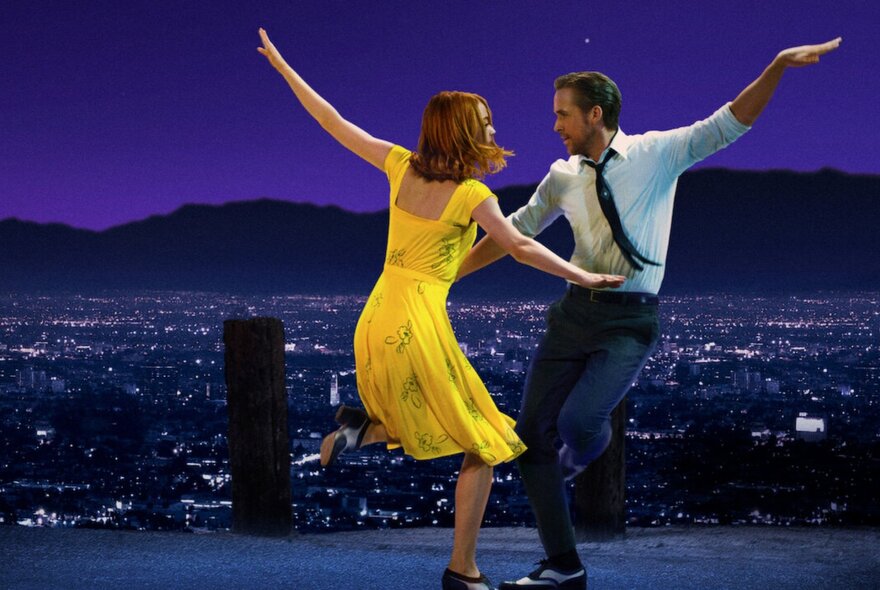
‘La La Land’ at 10: Justin Hurwitz on Bringing Hollywood’s Modern Musical Masterpiece to Australian Stages
By Sean Sennett
For Justin Hurwitz, revisiting La La Land isn’t simply an exercise in nostalgia. It’s a chance to experience the film the way audiences do — emotionally, collectively and in real time.
Nearly a decade after Damien Chazelle’s modern musical became a cultural phenomenon, Hurwitz is preparing to conduct the film live in concert for Australian audiences, with a full orchestra performing the Academy Award-winning score in sync with the movie.
And for the composer, those performances have fundamentally changed his relationship with the work.
“It keeps it alive for me,” Hurwitz tells us. “Every time I do a concert, I’m reminded what the movie means to people.”
That connection, he says, is impossible to replicate through streaming numbers or box office statistics.
“When you have thousands of people right behind you while conducting — I can hear them laughing and crying and sniffling — you really feel their energy,” he says. “Then I meet people afterwards and hear their stories. It becomes very special.”
Hurwitz will conduct the Sydney performances himself, while Australian conductor George Ellis leads the Melbourne and Brisbane concerts. Demand for the Sydney season has already prompted an additional show.
The live-to-film experience has become increasingly popular globally, but La La Land occupies a unique place within the format because of its hybrid musical identity — part sweeping orchestral romance, part intimate jazz performance.
“There’s an orchestra of about 52 musicians,” Hurwitz explains. “But within that there’s also a jazz combo — piano, bass, drums, guitar, trumpet, trombone and saxophone.”
That smaller ensemble becomes central during the film’s Lighthouse jazz club sequences, where improvisation enters the equation.
“The orchestral music is written down to every little dynamic and staccato marking,” he says. “But the jazz music is written like jazz. The musicians improvise solos every night, so the show is never exactly the same twice.”
That looseness and spontaneity sits at the heart of a film whose origins stretch back to Hurwitz and Chazelle’s Harvard years, when the pair bonded over MGM musicals, Disney scores and French New Wave cinema.
“We met when we were 18 and became roommates when we were 19,” Hurwitz recalls. “Damien introduced me to films like The Umbrellas of Cherbourg and The Young Girls of Rochefort. We were obsessed with musicals.”
The seeds of La La Land first emerged in a black-and-white student feature they made together, Guy and Madeline on a Park Bench, which acted as a prototype for the film’s emotional and musical language.
“That got the attention of an executive who started talking to us about developing a bigger musical, which eventually became La La Land,” Hurwitz says.
The road to getting there, however, was far from smooth.
“There were a lot of dumb ideas from people who didn’t trust us and wanted it to be something else,” he says with a laugh. “You’re always fighting for your vision.”
Hurwitz’s compositional process begins long before cameras roll. For La La Land, he started writing music from Chazelle’s original treatment — pages of prose outlining the emotional shape of the story before a screenplay even existed.
“I was developing melodies while Damien was writing the script,” he says. “We were working together through the entire process — development, pre-production, shooting and post.”
For the songs themselves, the timeline was particularly demanding. Large-scale production numbers like “Another Day of Sun” had to be completed before filming began, while quieter moments such as “City of Stars” required Hurwitz to perform live on set for the actors.
“I was playing piano directly into the actors’ ears while they sang,” he says.
“City of Stars” would eventually become one of the defining melodies of modern cinema, though Hurwitz insists inspiration did not arrive in one magical burst.
“I wrote a lot of things to get there,” he says. “You’re looking for a melody that captures all these emotional contradictions — yearning, cautiousness, melancholy, bittersweetness.”
Originally conceived as a song for Emma Stone’s Mia before shifting to Ryan Gosling’s Sebastian, the tune evolved gradually through countless drafts and melodic experiments.
Once Hurwitz and Chazelle found the melody they loved, songwriting duo Benj Pasek and Justin Paul were brought in to write lyrics.
“They sat at this very piano and sang, ‘City of stars, are you shining just for me?’” Hurwitz recalls. “Except for a couple of words, what they sang that first day is almost exactly what’s in the movie.”
If “City of Stars” represented intimacy and restraint, opening number “Another Day of Sun” posed an entirely different challenge.
“It was the hardest one to compose,” Hurwitz admits. “It had to balance hopefulness and heartbreak at the same time.”
The composer says the sequence needed to capture both the optimism and emotional exhaustion of Los Angeles dreamers — artists stuck in survival jobs while longing for something bigger.
“There’s sadness built into it,” he says. “Finding the balance of all those emotions was really hard.”
Hurwitz cites influences ranging from The Beach Boys and The Beatles through to Tchaikovsky, Offenbach and jazz-pop experimentalist Esquivel.
“All the music you listen to somehow stays in you,” he says.
Translating that sonic world into a live concert environment comes with enormous technical complexity. Scenes involving dialogue require delicate balancing between orchestra and film audio, while overlapping musical transitions demand split-second coordination.
“There are moments where part of the orchestra is fading out while another section is fading in and I’m conducting both at the same time,” Hurwitz says. “It gets pretty tricky.”
Yet for all the precision involved, Hurwitz believes the live performances ultimately allow audiences to experience the film in an entirely new way.
“You become much more aware of the music,” he says. “The score can really soar in a way it sometimes can’t inside a traditional film mix.”
For tickets https://www.hurwitzconcerts.com/la-la-land-in-concert