
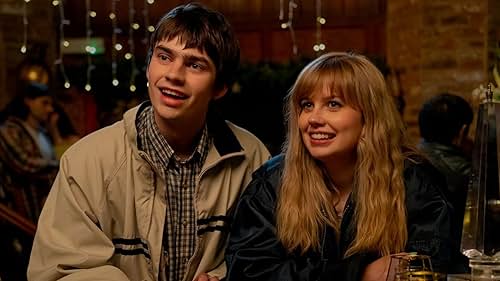
Manchester has always made outsiders feel like they belong. From the ghosts of Factory Records to the emotional sprawl of Oasis and The Smiths, it’s a city where heartbreak, ambition and late-night idealism have long collided under neon lights and rain-soaked streets. In Finding Emily, director Alicia MacDonald taps directly into that tradition, delivering a romantic comedy that feels both timeless and startlingly current.
Produced by Working Title Films — the studio behind classics like Love Actually, Notting Hill and Bridget Jones’s Diary — Finding Emily arrives carrying the DNA of great British rom-coms. But unlike many modern entries in the genre, this one isn’t polished into artificial perfection. It’s messy, funny, bruised and emotionally honest.
At the centre of the story is Owen, played with warmth and vulnerability by Spike Fearn. Owen is a musician and sound engineer working late shifts at Manchester City University’s student union when he meets a girl named Emily. There’s an immediate spark — flirtation, dancing, cheap drinks, possibility — before she disappears into the night with her friends. Owen grabs her number, but there’s one problem: a digit is missing.
That tiny mistake becomes the engine for one of the year’s most charming romantic comedies.
Armed with only a first name and the knowledge that there are more than 300 Emilys enrolled at the university, Owen launches a desperate search across campus. Enter Emily Raine, played by Australian actor Angourie Rice, whose sharply intelligent psychology student sees Owen less as a romantic hero and more as a walking thesis subject.
Emily is studying the futility of romantic attachment. Owen, meanwhile, believes love might still save him.
Naturally, chaos follows.
MacDonald says she wanted the film to combine “the nostalgia of cult classics like 10 Things I Hate About You and Clueless with the soul of When Harry Met Sally and the screwball comedy spirit of His Girl Friday.” The result feels exactly like that — a collision between old-school romantic yearning and the emotionally over-analysed landscape of modern dating culture.
What elevates Finding Emily above formula is its refusal to idealise romance. Screenwriter Rachel Hirons built the film around a deceptively simple question: “When does romantic become ridiculous? When does love become lunacy?”
It’s a smart premise because Owen’s grand gesture — trying to track down a woman after one magical night — would have been applauded in a 1990s rom-com. In 2026, it risks becoming something else entirely. The film understands that tension and mines it brilliantly.
Hirons initially set the screenplay in Los Angeles before relocating it to Manchester, a move that gives the film much of its soul. The city doesn’t merely serve as backdrop here — it becomes another character entirely. The film pulses with Manchester music culture, student nightlife, football obsession and that strange emotional volatility that accompanies the final year of university life.
MacDonald captures it beautifully.
“The hope was to cinematically harness all that raw and bustling student energy,” she explains. “The last year of uni was an emotional riot.”
That spirit runs through every frame. There’s an almost tactile quality to the film — crowded student bars, fluorescent lecture halls, cider-fuelled nights, awkward hookups and endless conversations about what adulthood is supposed to look like. The emotional stakes feel real because the characters themselves feel recognisable.
Rice is particularly terrific. Best known internationally for projects like Mare of Easttown and the recent Mean Girls adaptation, she gives Emily a restless intelligence that constantly threatens to crack under emotional pressure. Emily is cynical, hyper-articulate and ambitious, yet beneath all that analysis sits someone just as confused and vulnerable as Owen.
Fearn, meanwhile, avoids every cliché associated with the traditional rom-com leading man. He isn’t slick or impossibly confident. He’s awkward, emotional and occasionally naïve, which makes him instantly relatable. Producer Olivier Kaempfer describes him perfectly when he says Fearn has “all the magnetism you’d expect of a leading man, but in a relatable and endearing way.”
Together, Rice and Fearn have genuine chemistry — not the overly manufactured kind, but the sort built from tension, contradiction and uncertainty. Watching them challenge each other becomes the emotional heartbeat of the film.
There’s also an impressive supporting cast orbiting around them. Minnie Driver brings sharp comic authority as Dean Emily Watkinson, while Prassana Puwanarajah steals scenes as Emily’s dissertation advisor and devoted Wham! fan Professor Westlake.
Visually, MacDonald leans into intimacy over spectacle. Cinematographer Rachel Clark frames the characters with warmth and closeness, allowing conversations and silences to breathe naturally. Editor Phil Hignett gives the film a flowing musical rhythm, while composer Morgan Kibby layers the emotional beats with a score that complements the film’s broader love affair with Manchester’s music legacy.
That connection to music matters. Deeply.
Like the best British romantic comedies, Finding Emily understands that songs often say what characters can’t. MacDonald fills the film with new-wave classics, contemporary Manchester artists and emotionally charged needle drops that help define the emotional temperature of entire scenes.
In many ways, Finding Emily feels like a throwback — but in the best possible sense. It remembers that romantic comedies work best not when they’re glossy fantasy, but when they acknowledge how frightening it is to genuinely care about another person.
By the time the film reaches its final stretch, what lingers isn’t simply the romance. It’s the aching recognition that modern connection has become both easier and harder than ever before. Everyone is online. Everyone is reachable. Yet genuine emotional intimacy remains terrifyingly elusive.
That’s what makes Finding Emily resonate.
Beneath the laughs, awkward encounters and campus-wide frenzy is a film asking whether sincerity still has a place in a deeply cynical world. Thankfully – the answer is a resounding yes!
Mitchell Peters