
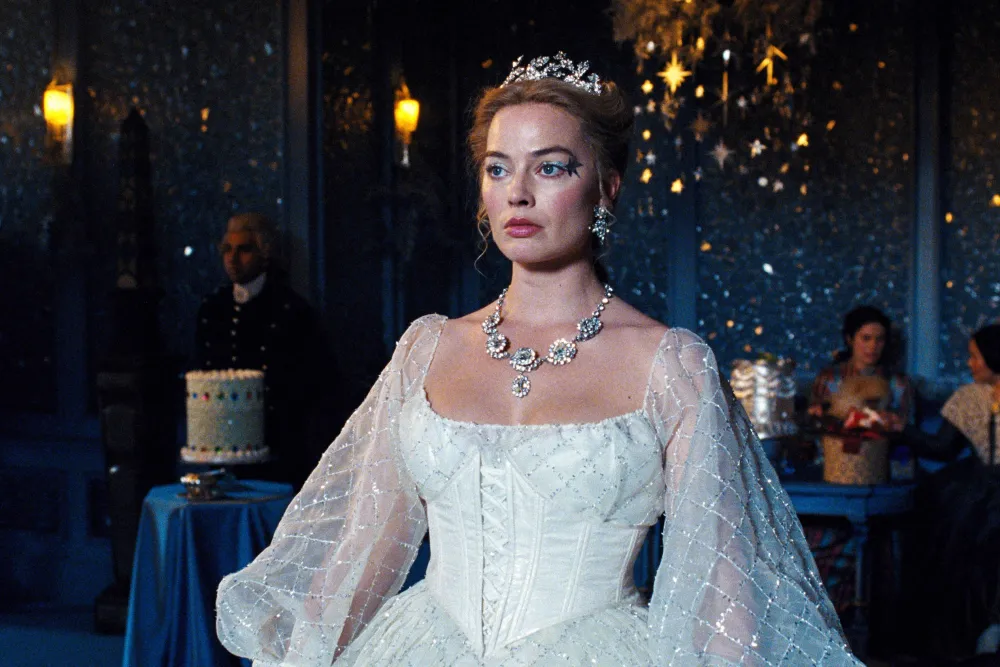
“Wuthering Heights”
Dir: Emerald Fennell
4/5
There are quotation marks around the title for a reason.
This is not Wuthering Heights as you know it. It is “Wuthering Heights” — a provocation, a fever dream, a velvet-gloved act of vandalism against literary orthodoxy. And thank God for that.
Director Emerald Fennell has never been interested in tasteful museum pieces. From the candy-coated vengeance of Promising Young Woman to the decadent psychosexual spiral of Saltburn, she has carved out a cinematic language that feels both baroque and razor sharp. With “Wuthering Heights,” she completes what now feels like a trilogy of fine, audacious films — works obsessed with class, obsession, erotic power and the rot beneath polite society.
Purists will bristle. They already are. This is no longer a faithful homage to Wuthering Heights by Emily Brontë. The windswept Yorkshire moors of the original have been filtered through Fennell’s pop-gothic imagination. Time collapses. Dialogue occasionally fractures into something stylised and surreal. Emotional logic overrides narrative fidelity.
But that’s the point.
You don’t “adapt” Wuthering Heights in 2026 by tracing its outlines. You interrogate it. You let it bleed.
And in Margot Robbie, Fennell finds the perfect Catherine Earnshaw for this warped landscape. Robbie doesn’t play Cathy as a romantic heroine — she plays her as a storm system. She’s volatile, funny, frightening, and erotically charged in ways that feel both contemporary and timeless. There’s a feral intelligence in her performance that makes you understand why men would burn down their lives for her — and why she might happily hand them the match.
Opposite her, Jacob Elordi’s Heathcliff is rendered less as brooding Byronic fantasy and more as wounded animal. Elordi leans into the character’s volatility, stripping away romantic varnish and exposing something raw and dangerous underneath. The chemistry between the leads is combustible and occasionally uncomfortable to watch. There are scenes that feel like knife fights disguised as love scenes.
Some will object to the casting choice that erases Heathcliff’s racial ambiguity — a long-debated aspect of Brontë’s novel. It’s a fair critique. The film sidesteps rather than confronts that dimension. But if you can momentarily forgive the whitewashing — and that forgiveness won’t come easily for everyone — you’ll find Elordi delivers a performance of real depth and physicality that anchors the role.
What Fennell is after here isn’t literary accuracy. It’s emotional extremity.
Visually, “Wuthering Heights” is a knockout. The film leans hard into an avant-garde aesthetic: corsets that feel sculptural rather than historical, colour palettes that swing from bruised purples to bleached bone whites, wind machines that howl like industrial fans in a fashion editorial. The costumes are not simply period-appropriate; they’re confrontational. Gothic romance meets high-concept runway. It’s as if Alexander McQueen designed a Brontë hallucination.
The camera rarely rests. Interiors glow like oil paintings, then shatter into disorienting close-ups. The moors are less pastoral and more psychological — vast emotional landscapes rather than geography. At times, the film feels like it’s happening inside Catherine’s nervous system.
And yes, parts of it are deeply unsettling.
There are moments of cruelty that linger longer than comfort would allow. Scenes of emotional manipulation play out without the safety net of moral framing. The violence — physical and psychological — is intimate and suffocating. But that discomfort is the point. Art is not meant to soothe. It’s meant to provoke, to disturb, to pull something uneasy to the surface.
Fennell understands that the novel’s power has always been its toxicity — its refusal to offer clean redemption arcs. This adaptation amplifies that ugliness until it becomes operatic.
The supporting cast leans into the stylisation with conviction, but this is ultimately a two-hander. Robbie is fearless, fully committed to the madness. Elordi matches her beat for beat, grounding the film’s flights of aesthetic indulgence in raw, bruised humanity.
If the film occasionally indulges itself — and it does — it does so with confidence. Some sequences feel more like mood pieces than storytelling. But even at its most excessive, “Wuthering Heights” never feels timid. In an era where prestige adaptations often arrive embalmed and reverent, Fennell has made something alive and unruly.
The quotation marks around the title are a warning label. This is not the book you studied. It’s not even the book you remember. It’s a remix, a fever dream, a bold swing at a sacred text.
And it mostly lands.
Four stars for ambition. Four stars for performances that feel dangerous. Four stars for a director completing a remarkable trio of films that refuse to play safe.
You may not recognise “Wuthering Heights.”
But you won’t forget it.
Mitchell Peters