
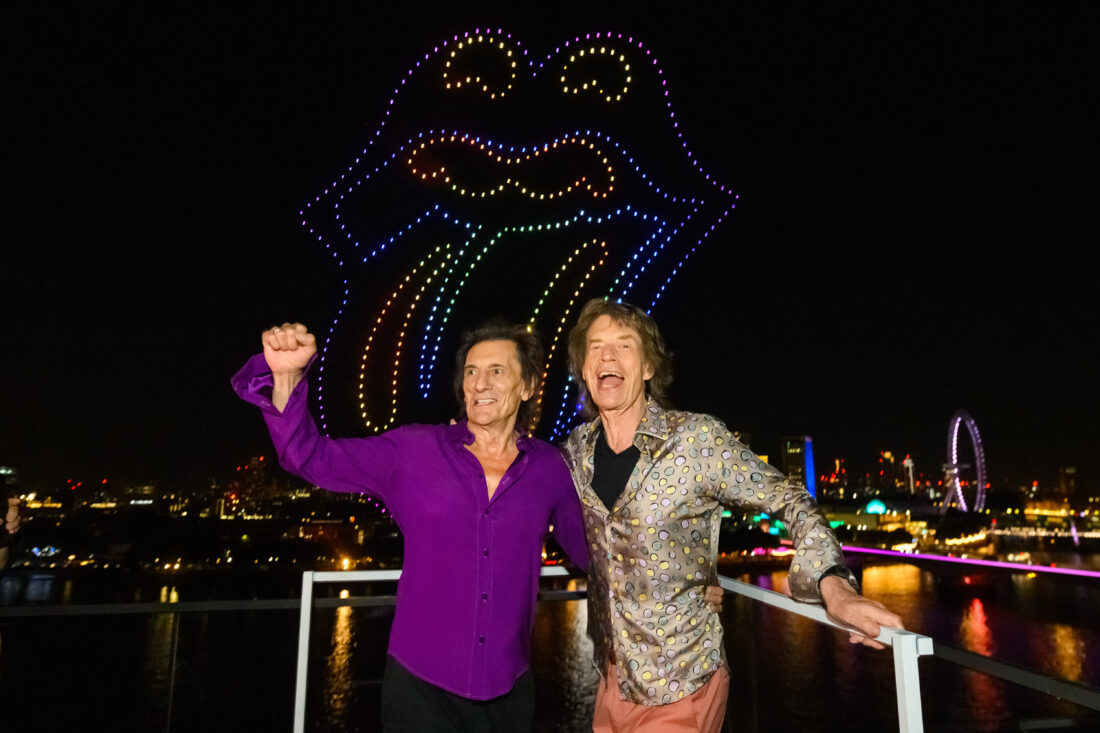
The Rolling Stones – Foreign Tongues
There comes a point where every new Rolling Stones album stops being judged against the impossible standards of Exile On Main St., Sticky Fingers or Let It Bleed and starts being judged against something far more interesting: the expectations of time itself.
After all, Mick Jagger is in his eighties. Keith Richards has somehow transformed from rock’s most notorious survivor into its wisest elder statesman. Ronnie Wood still attacks a guitar with the enthusiasm of a teenager discovering Chuck Berry records for the first time. By every conventional measure, Foreign Tongues shouldn’t exist. Yet here it is – not as a victory lap or an exercise in nostalgia, but as another reminder that the world’s greatest rock ‘n’ roll band still has something to say.
If Hackney Diamonds announced that the Stones were back, Foreign Tongues confirms it wasn’t a one-off.
Produced once again by Andrew Watt, the album captures the band with remarkable confidence. Watt understands that producing the Rolling Stones isn’t about reinventing them or burying them beneath modern production tricks. It’s about creating enough space for that magical push and pull between Jagger’s restless energy, Richards’ instinctive feel and Wood’s irrepressible sense of adventure.
That chemistry was clearly evident during the recording sessions at Metropolis Studios in London. Reflecting on the experience, Mick Jagger said: “I loved doing these recording sessions in London at Metropolis. It was a very intense few weeks recording Foreign Tongues. We had 14 great tracks and we went as fast as we could. I like the room there as it’s not too big so you can feel the passion from everyone.” That intimacy comes across on the finished record, which sounds immediate rather than overworked.
The opening tracks arrive with swagger to spare, while the album’s strongest moments balance muscular guitars with some of Jagger’s most committed vocals in years. There is an urgency here that many bands half the Stones’ age would struggle to summon. Rather than sounding like musicians trying to recreate their youth, they sound like artists liberated from having to prove anything.
That freedom becomes one of the album’s defining qualities.
Lyrically, Foreign Tongues looks outward as often as it looks back. There are reflections on mortality, flashes of political unease and plenty of the sly humour that has always been one of Jagger’s strengths. The songs don’t preach; they observe, often with a raised eyebrow and a crooked smile. Age hasn’t dulled his instinct as a storyteller—it has simply broadened his perspective.
Keith Richards remains the emotional heart of the record. His guitar playing still finds that glorious space between precision and beautiful imperfection, while his vocal contributions carry a warmth that only comes from experience. Richards has often described the Rolling Stones as being “like a marriage,” and it’s difficult to imagine a better description. After more than six decades together, there is an unspoken understanding between these musicians that simply cannot be manufactured. They know when to push, when to hold back and, most importantly, when to leave space for one another.
That sense of continuity is something Richards himself recognises. “The Foreign Tongues album has a continuity from Hackney Diamonds and it was great to be working in London again, and to have that London vibe around us,” he said. “It was a month of concentrated punch. To me, it’s all about the enjoyment of it. I’m blessed to be able to do this and long may it last.” It’s an attitude that runs through every groove of the record. Rather than sounding burdened by legacy, the Stones still sound thrilled to be playing together.
Ronnie Wood continues to be the band’s secret weapon. His playing dances around Richards rather than competing with him, adding colour and momentum at every turn. Looking back on the sessions, Wood recalled: “The atmosphere in the room was so creative, and the whole band was on top form throughout the whole process. Very often we nailed it on the first take. I hope everyone loves it.” Listening to Foreign Tongues, that spontaneity is impossible to miss. Beneath all the history and mythology remains the unmistakable sound of three musicians who genuinely enjoy making music together.
Then there is Charlie Watts.
Although Steve Jordan now provides the driving force behind the Stones’ rhythm section, Charlie Watts makes a poignant final appearance behind the kit on Never Wanna Lose You, a performance preserved from the original Hackney Diamonds sessions. It may be his only drumming contribution to Foreign Tongues, but its significance extends well beyond a single track. Watts’ playing was always about feel rather than flash, and his unmistakable swing remains embedded in the Rolling Stones’ DNA. Even when he isn’t physically present, his musical spirit continues to shape the band’s sound.
Keith Richards also takes centre stage just once as lead vocalist on Some of Us. His weathered, unmistakable voice has never been about technical perfection; it’s about character, wisdom and soul. Used sparingly here, it provides one of the album’s most affecting moments and offers the perfect contrast to Jagger’s commanding performances elsewhere on the record.
Among the album’s most enjoyable surprises is a spirited reading of Amy Winehouse’s You Know I’m No Good. Rather than trying to outdo the original, the Stones filter the song through their own blues-and-R&B vocabulary, uncovering fresh nuances while paying genuine respect to one of Britain’s finest modern songwriters. It’s an inspired choice that feels entirely at home alongside the band’s own material and a reminder that, even after six decades, the Rolling Stones remain curious enough to celebrate artists who followed in their footsteps.
The guest appearances are handled with similar restraint. They add texture rather than distraction, enhancing the record without ever threatening its identity. That’s a testament not only to the guests themselves but to the confidence of a band that has never needed outside validation.
If there’s one criticism, it’s that Foreign Tongues occasionally tries to embrace every corner of the Stones’ musical personality. Blues, country, soul, hard rock and pop all jostle for attention, and not every stylistic detour lands with equal impact. There are moments when a tighter edit might have elevated an already impressive album into something even stronger.
Still, those are relatively minor reservations.
What lingers long after the final track fades is the sheer joy of the performances. Too many legendary bands continue recording because audiences expect them to. The Rolling Stones sound as though they’re still doing it because they genuinely can’t imagine not doing it.
Perhaps that’s the real story behind Foreign Tongues.
The Stones have survived changing fashions, punk, disco, MTV, Britpop, streaming and countless predictions that every tour and every album would surely be their last. Yet they continue to confound expectations. Mick Jagger himself has acknowledged that they “can’t continue forever,” and perhaps he’s right. Time catches everyone eventually.
If Foreign Tongues ultimately proves to be the band’s final studio statement, it is an immensely satisfying way to close the circle. It doesn’t attempt to relive former glories. Instead, it celebrates everything that has always made the Rolling Stones unique: the swagger, the humour, the tension, the groove and, above all, the chemistry between musicians who still surprise one another.
No, Foreign Tongues isn’t trying to sit alongside Exile On Main St. or Sticky Fingers. Those albums changed the course of popular music.
This one achieves something different.
It reminds us that genuine creativity doesn’t have an expiry date. More than sixty years after they first plugged in their guitars, the Rolling Stones are still speaking a language that millions of people around the world understand. It may be called Foreign Tongues, but for anyone who has loved rock ‘n’ roll over the past six decades, it feels wonderfully familiar.
Peta Kent