
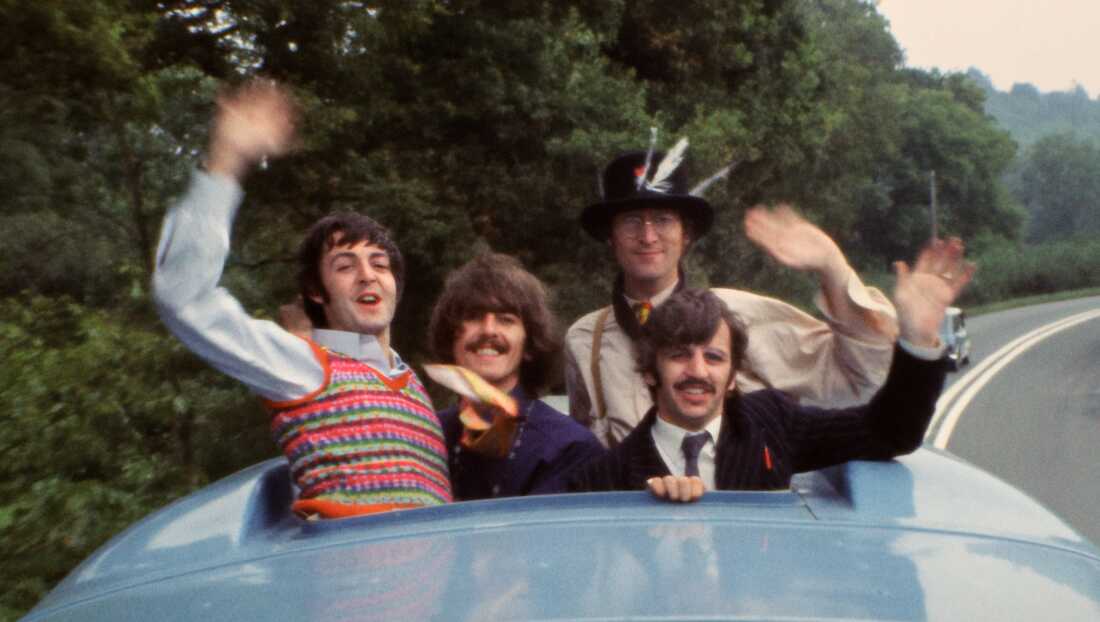
In the fall of 1995, The Beatles took over prime-time television like it was 1964 all over again. Families gathered around boxy TVs, VCRs hummed, and a brand-new Beatles song, “Free As a Bird,” fluttered out over network airwaves, stitched together from a John Lennon demo and the surviving trio’s studio magic.
That moment was the gateway drug for something even bigger: The Beatles Anthology, an eight-part TV deep dive that didn’t just retell the band’s story—it rewired how we think about rock documentaries, and about The Beatles themselves.
Three decades on, Anthology is back in a newly restored, recut version—complete with a ninth episode—and it still feels like the definitive Beatles film, even as it keeps admitting that “definitive” is a mirage.
From wartime Liverpool to the end of the world
The story still begins in black and white, in the bombed-out streets of wartime Liverpool, and ends in a world completely remade by the ’60s. In between, the series bounces from the clubs of Hamburg to swinging London, from screaming American arenas to ashrams in India.
But what gives Anthology its charge isn’t the geography. It’s the way the series locks onto four people at the center of the storm—John, Paul, George and Ringo—remembering what it was like to live inside a band that moved faster than the culture around them.
When Anthology first aired, it quietly detonated the idea of the traditional rock doc. There’s no omniscient narrator, no parade of “expert” talking heads explaining the Beatles back to you. Instead, the band tell their own story, in their own voices, with all the contradictions, jokes and emotional whiplash left in.
“You’ve heard it from everybody else,” Ringo says at one point. “Now you can hear it from us.”
The result didn’t just introduce The Beatles to a new generation; it kicked off the modern phase of their afterlife—reissues, remixes, deep-dive projects—that’s still in full swing today. The way we now instinctively talk about The Beatles’ arc—from sweaty Cavern Club to rooftop farewell—largely starts here.
The long and winding road to Anthology
The roots of Anthology go all the way back to the immediate aftermath of the breakup. In the early ’70s, the band’s confidant and fixer Neil Aspinall started quietly collecting film, performance clips and newsreel footage, assembling a feature-length rough cut called The Long and Winding Road. There were no new interviews with the band—things were still too fresh, too raw—but the project made one thing very clear: this story would eventually have to be told properly.
Then it sat. Through the ’70s and ’80s, the film lived in limbo while the ex-Beatles untangled business disputes, rebuilt their own lives, and, in Lennon’s case, were taken away far too early.
“When we got over our business troubles, we decided that we might do the definitive story of The Beatles,” Paul McCartney later said. The key, he realised, was simple: “Seeing as other people had had a go at it, we thought it might be good from the inside-out, rather than the outside-in.”
By the early ’90s, the surviving Beatles were ready to look back. Paul, George and Ringo started spending time together again, talking about what this thing could be. New interviews were filmed with British musician and broadcaster Jools Holland; Lennon’s words were woven in from a carefully assembled archive of his past interviews. Insiders like Aspinall, producer George Martin and press officer/strategist Derek Taylor added their perspectives.
UK filmmakers Geoff Wonfor and Bob Smeaton then set to work, taking Neil’s early efforts and building out a sprawling, eight-part narrative, stitching archival gold into something that felt both mythic and strangely intimate.
Right band, right time—again
By the time Anthology finally landed in the mid-’90s, The Beatles’ legacy had gone a little out of focus, at least in their home country. For a while, their story had slipped towards the background—still respected, but not especially “cool.”
Then the culture looped back. The Beatles’ psychedelic adventures were all over the UK’s acid house and rave scenes that erupted in the late ’80s. Kurt Cobain openly worshipped them; you could hear it tucked inside Nirvana’s heaviness. The Britpop wave—Blur, Oasis, Pulp—was largely powered by musicians born right around the time The Beatles were breaking up, all of them in debt to the Fabs.
Suddenly, the world was ready for a multi-hour, multi-night deep immersion in the band’s universe. And The Beatles were ready to reintroduce themselves.
“Free As a Bird” led the charge: Lennon’s ghost on tape, completed by Paul, George and Ringo, soundtracking a video that floated through Beatles landmarks and in-jokes like some surreal guided tour. Then came the first of three Anthologyalbums, packed with outtakes and rarities that played like a shadow history running alongside the main story.
The four Beatles had gone their separate ways a quarter-century earlier. Yet, somehow, here they were again—simultaneously past and present, fragile and larger than life.
Rebuilding the revolution: the restoration
Fast-forward to now. The newly restored Anthology is proof that The Beatles’ story can still feel shockingly alive—thanks not just to the band’s own electricity, but to an obsessive amount of work behind the scenes.
When the series was first produced in the ’90s, the new interviews with Paul, George and Ringo (and key associates) were shot on 16mm film. That’s a gift to modern archivists: three decades later, those reels can be scanned and cleaned up into something crisp and luminous without too much drama.
The real challenge lay elsewhere: in the mountain of archival footage that captured The Beatles at every stage of their ascent, much of it originally sourced from TV stations and filmmakers across the world. Apple’s team feared that the original film elements had been tossed long ago in favor of cheaper videotape transfers.
They got lucky. As 2025 co-producer Martin R. Smith recalls, almost every archive came back with the same answer: the original film was still there, sitting in cans. What they’d expected to be a salvage job turned into an “embarrassment of riches.”
From there, the project moved to Peter Jackson’s Park Road facility in New Zealand—the same outfit that did the sorcery on his Get Back series. Teams of restoration artists went through thousands of sequences frame by frame, removing scratches, chemical blotches, warped frames and stray hairs from camera gates, while preserving the natural grain and texture that makes ’60s film feel like the ’60s.
The goal wasn’t to make The Beatles look like they were shot yesterday. It was “to retain the flavour of the 1960s, but with a quality fit for the twenty-first century”—to let the Cavern Club in 1962, the Maysles brothers’ footage of that first U.S. trip, the Magical Mystery Tour weirdness, and the promo clips for “Hey Jude” and “Revolution” all shine without losing their period soul.
On the audio side, producer Giles Martin oversaw a similarly radical cleanup. Working with sound teams at Park Road and Jackson’s WingNut operation, the engineers used a machine-learning system nicknamed MAL (after roadie Mal Evans) to “demix” the original tapes—separating instruments, voices and crowd noise buried together on old mono and stereo recordings.
Beatles live tapes were notoriously rough: dodgy recording gear, chaotic conditions, and that ungodly wall of screams. For the first time, those screams could be peeled back to reveal the band’s actual on-stage power underneath—what one insider likens to “lifting a veil.” Dialogue and music for each episode were restored and remixed in Dolby Atmos, 5.1 and stereo, pulling you deeper into the rooms, the vans, the planes, the control booths where the story unfolded.
Crucially, the team also applied that same care to John Lennon’s archival interviews, which often came fused to music and background clatter. The new mixes let his voice float to the foreground with a directness that can feel eerie. It’s as if he’s stepped a little closer.
A new cut for a new audience
The 2025 Anthology isn’t just a polish job; it’s a rethink. Apple’s UK production team took the original eight sprawling episodes and tightened them, trimming each one to just under an hour to create a stronger, more focused narrative. The entire post-production process—online edit, picture restoration, sound work, grading—was handled at Park Road.
There’s also a brand-new Episode Nine, a kind of epilogue that pulls together footage of Paul, George and Ringo reconvening in the ’90s: sitting for joint interviews, jamming together, listening back to Beatles records with George Martin and trying, in real time, to make sense of the thing they’d built.
From Episode One, the arc still hits like a myth. We start in 1940s Liverpool, move through the formative Hamburg crucible, and watch “Please Please Me” hit No. 1 in a winter that feels both distant and immediate. Beatlemania erupts in Britain, then America. Drugs, fame and boredom crack open the band’s perception and point towards the radical leaps of Rubber Soul and Revolver.
By the mid-’60s, the story tilts darker. The creative breakthrough of 1966 runs alongside undercurrents of danger: hostile treatment from the regime in the Philippines, and the furious backlash in the American South after John’s “bigger than Jesus” comment. In these episodes, Anthology doesn’t smooth over the fear and resentment—they’re baked in.
And then, somehow, out of that chaos comes Sgt. Pepper’s Lonely Hearts Club Band, one of the most audacious studio statements ever made. After manager Brian Epstein’s sudden death and the messy, misunderstood Magical Mystery Tour, they head to India and write most of what became the so-called White Album.
Apple Corps rises and then implodes. Drug busts, police pressure and business chaos drag the band towards breakup. But even as things fracture, Anthology shows them conjuring Let It Be and Abbey Road, still guided—however shakily—by the philosophy John later distilled in one of their final lyrics: “And in the end / The love you take / Is equal to the love you make.”
Along the way, the series keeps underlining something that often gets lost in all the iconography: how much these four men genuinely loved each other.
“They became the closest friends I’d ever had,” Ringo says. “I was an only child and suddenly I felt as though I’d got three brothers. We really looked out for each other.” At the end of the original run, he sums it up even more bluntly: “It was magical. Some really loving, caring moments between four people. A really amazing closeness. That four guys really loved each other was pretty sensational.”
John, for his part, swats away the cynics. “I’ve read cracks about, ‘Oh, The Beatles sang “All You Need Is Love,” but it didn’t work for them.’ But nothing’ll ever break the love we have for each other.”
Paul adds a coda that feels, in 2025, like a mission statement. “I’m really glad that most of the songs dealt with love, peace, understanding,” he says. “They really did. If you look back, there’s hardly any one that says, ‘Go on, tell ’em all to sod off, leave your parents.’ It’s all very ‘All You Need Is Love,’ John’s ‘Give Peace a Chance’—there’s a very good spirit behind it all.”
Many stories, one band
One of the smartest things the new Anthology does is refuse to pretend there’s one neat, agreed-upon Beatles story.
“We started off trying to make the definitive story of The Beatles,” Paul admits in the new coda. “And we ended up realising that it’s almost impossible to get the definitive story, because people look at things from different points of view.” He shrugs it off with a line that feels like hard-won wisdom: “That’s how life really is. You live this dream that there’s a definitive version, and there isn’t.”
George puts it even more plainly: “Everybody sees life as it’s happening through their own eyes. And when you get a situation like The Beatles’ story, everybody had their own idea of what happened.”
The series leans into those mismatches. George remembers the White Album as a record with “a lot more individual stuff”; Ringo thinks they ended up “more of a band again.” The fabled 1965 meeting with Elvis Presley is recalled differently by different Beatles, though George clearly remembers asking if anyone had any reefer. The Let It Be sessions—now reframed by Jackson’s Get Back—are presented as both tense and playful, depending on whose story you’re listening to.
Every episode begins with the same image: The Beatles hammering through “Help!” in black and white as the band’s logo grows so big it swallows them up. It’s a neat metaphor for what happened while the band was together and for decades afterwards: the mountain of myth, marketing and nostalgia ballooning so huge that the actual people vanish from view.
What Anthology does—especially in this new incarnation—is chip away at that mountain until the human beings shine through again.
Living at five times normal speed
Watching Anthology in 2025, in an era when artists take four-year breaks between albums and “hiatus” is a career strategy, the sheer velocity of The Beatles’ story feels almost supernatural. No multi-year gaps, no carefully staged disappearances—just an insane torrent of work and change.
The world around them shapeshifts just as quickly. Ask yourself: does 2025 really feel that far from 2019? Now compare 1963 to 1969. They might as well be separate universes, and The Beatles were at the crow’s nest for that entire trip.
“We were all in this ship in the ’60s…a ship going to discover the New World,” John once said in a line quoted in the original Anthology book. “And The Beatles were in the crow’s nest…We were going through the changes, and all we were saying was, ‘It’s raining up here!’ or ‘There’s land!’ or ‘There’s sun!’ We were just reporting on what was happening to us.”
That’s what the best moments of Anthology still feel like: dispatches from the crow’s nest, sent by four young men who had no idea they were rewriting the culture as they went.
“The Beatles exist without us”
We’re now more than half a century past the breakup, in a world where the musical past is terrifyingly easy to access—where a kid can stream “Now and Then” seconds after stumbling onto “I Want to Hold Your Hand” on TikTok.
The new Anthology slots neatly into that landscape, but it also stands apart from it. It’s longform in a short-attention world, a patient piece of storytelling in an era of chopped-up clips and hot takes. It’s also, in its own way, the Beatles project that best understands the strange fate of this band in the 21st century.
“The Beatles will go on and on—on those records and films and videos and books and whatever, and in people’s minds,” George Harrison said as Anthology was first coming together. “And The Beatles, I think, exist without us.”
That’s the haunting conclusion the new series arrives at too. The band’s afterlife is now so rich—remixes, restorations, documentaries, final songs pulled from cassettes—that The Beatles feel less like a group that ended and more like a story that keeps finding new ways to tell itself.
The new Anthology doesn’t try to pin that story down. It just sharpens it, deepens it, and lets the four men at the center speak a little more clearly across the noise.
It’s not the final word on The Beatles. There will never be one. But as a piece of rock storytelling—honest, funny, conflicted, exhaustive—it’s still the one that towers over everything else.
The Beatles Anthology is screening now on Disney+