
Ainsley Mura
Fans of The Hunger Games have waited eagerly to see the carnage of the second Quarter Quell unfold on the big screen. With Sunrise on the Reaping now in cinemas, that wait is over. The franchise’s second prequel follows a young Haymitch Abernathy, played by Australian actor Joseph Zada.
Much of the anticipation comes from Woody Harrelson’s portrayal of the older Haymitch, which hinted at the trauma behind his victory. Then there is the premise: with twice as many children reaped from Panem’s 12 districts, how could the odds ever be in his favour?
Having directed four of the five previous Hunger Games films, Francis Lawrence returns as director and producer. While maintaining the franchise’s visual identity, Sunrise on the Reaping reveals a different side of Panem.
Zada has some Harrelson-sized shoes to fill, but there is little cause for concern. His portrayal builds on the foundations laid by Harrelson while establishing a Haymitch who feels entirely his own. Across the film’s 158 minutes, Zada masterfully captures his character’s growing disillusionment as his innocence slips away.
The result is the series’ most faithful adaptation yet. The unconventional circumstances surrounding Haymitch’s reaping begin with his girlfriend, Lenore Dove (Whitney Peak), who unwittingly sets in motion the events awaiting him. Their relationship provides an emotional anchor throughout the film, with Peak and Zada’s chemistry lending poignancy to Haymitch’s desire to protect those he loves.
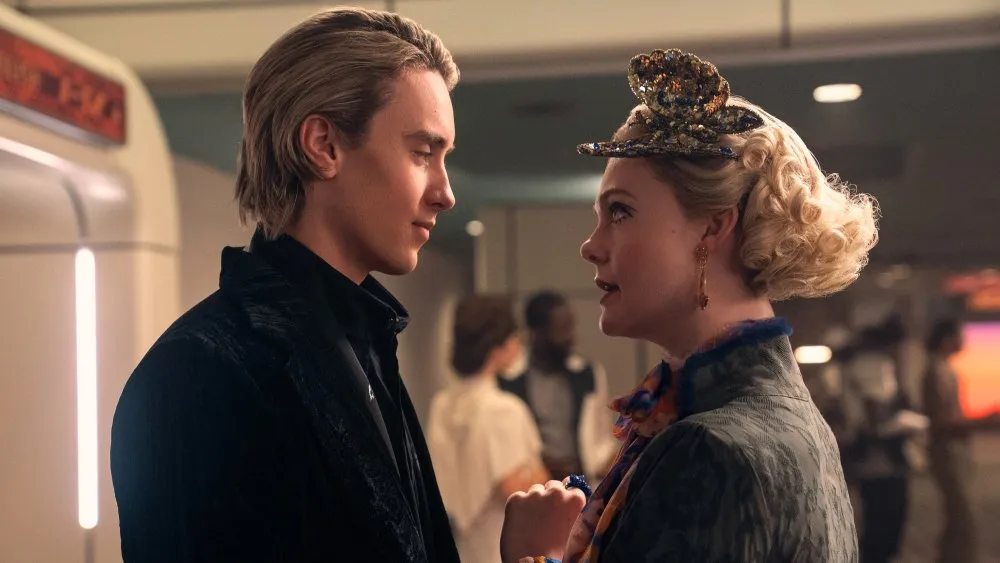
District 12’s reaping introduces the other tributes: Wyatt Callow (Ben Wang), Louella McCoy (Molly McCann) and Maysilee Donner (Mckenna Grace). Presiding over proceedings is the Capitol’s eccentric Drusilla Sickle (Glenn Close). Close’s transformation into the garish Drusilla is as impressive as it is eerie. While the young cast hold their own, Grace stands out, delivering her best performance yet as Maysilee.
More familiar characters appear once the tributes arrive in the Capitol, including President Snow (Ralph Fiennes), Caesar Flickerman (Kieran Culkin), Mags Flanagan (Lili Taylor), Wiress (Maya Hawke) and Beetee (Kelvin Harrison Jr.). Culkin captures Caesar’s familiar blend of charm and smarminess, while Fiennes embodies Snow’s ruthlessness.
It is Jesse Plemons’ grounded portrayal of Plutarch Heavensbee, previously played by the late Philip Seymour Hoffman, that elevates the film and the performances around him. Where Hoffman brought morally ambiguous complexity to the role, Plemons introduces a youthful optimism that dims before flickering back to life at the prospect of rebellion. It is a brilliant piece of casting.
The arena offers another striking departure: a picturesque meadow of rolling hills, abundant wildlife and flowers, with a lone volcano looming beyond. The cinematography makes the landscape mesmerising, but its beauty conceals lethal dangers. As Haymitch steps into the arena, the image expands to the IMAX aspect ratio, deepening the sense of immersion in the Games.
Suzanne Collins’ critique of propaganda, and its power to reshape the public’s understanding of Haymitch’s Games, feels pointed in the current political climate. The message may be heavy-handed, but it is welcome.
The Hunger Games has always resonated with young audiences for reasons that extend well beyond its brief, brutal bloodbaths. At its best, the series encourages viewers to question how power operates — and what happens when it goes unchecked.