
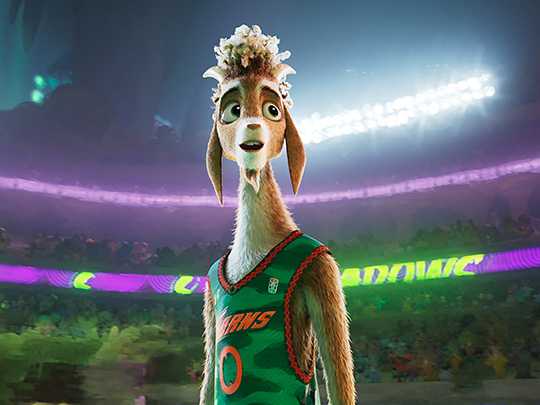
There’s something beautifully absurd about a goat trying to posterize a rhinoceros.
From Sony Pictures Animation — the studio that bent the multiverse into neon shards with Spider-Man: Across the Spider-Verse — comes GOAT, an original action-comedy set in a fully anthropomorphic animal kingdom where basketball isn’t just a game, it’s a full-contact survival sport called roarball. Think hardwood meets National Geographic, with tunnel walks, signature sneakers and enough swagger to fuel a mixtape.
At the center is Will Harris, a small goat with a vertical leap in his heart if not his limbs. Voiced by Caleb McLaughlin, Will earns a once-in-a-lifetime shot to join the pros in a league dominated by the biggest, fastest and fiercest animals on the planet. His new teammates — rhinos, giraffes, ostriches, Komodo dragons — are not exactly thrilled to see a “small” trotting into their locker room. But Will isn’t there to blend in. He’s there to change the game.
Director Tyree Dillihay calls it “a generation-defining underdog story,” and you can hear the grin in his voice. “Great sports movies are emotional, inspirational and transcendent,” he says. “But this idea of rhinos, polar bears and this tiny goat — with oversized bling, tunnel walks and signature sneakers — dribbling, dunking and setting picks made me laugh out loud from the beginning.”
The concept is deliriously simple: in a world where “bigs” and “smalls” live side by side, culture doesn’t discriminate — but roarball does. The sport is played on oversized courts riddled with natural obstacles: cracking sheets of ice, writhing vines, unpredictable terrain. Producer Michelle Raimo Kouyate describes it as a place where players “run on two paws, four paws, use their tails, horns, snouts, wings, tongues — anything goes.” Anything, that is, except being small.
Co-producer David Schulenburg explains the taboo: “Roarball is so dangerous — the pace, the terrain — that the idea of a small goat playing is unheard of.” It’s less Hoosiers, more Hunger Games with a halftime show.
Still, Will’s dream began when he was a kid in Vineland, the birthplace of roarball — a city imagined as Brooklyn colliding with Brazil, jungle canopy wrapped around brownstone grit. Dillihay calls it “a visual gumbo you’ve never seen before.” It’s here that Will’s mother teaches him the film’s core philosophy: play your game, work hard, and don’t let the world define your ceiling.
If that sounds familiar, it’s because four-time NBA champion Stephen Curry is producing the film through Unanimous Media — and even lending his voice to Lenny Williamson, a giraffe with bars and a jump shot. Curry knows something about being underestimated. “My journey resembles Will’s,” he says. “Being overlooked, underrated — but finding your self-confidence through it all. And it’s about the power of the team. You can’t do anything great without the people around you.”
Curry’s fingerprints are all over the film’s cultural texture. The accessories. The fits. The soundtrack. “If you watch it 20 years from now,” he says, “you’ll go back to a moment in time.” The film doesn’t just parody basketball culture — it celebrates it, from the absurdity of pre-game theatrics to the mythology of the MVP.
That MVP, Mane Attraction — voiced by Aaron Pierre — is pure apex predator confidence. Meanwhile, the Vineland Thorns roster reads like an All-Star ballot from a fever dream: Gabrielle Union as veteran legend Jett Fillmore; Nicola Coughlan as high-strung ostrich Olivia Burke; Nick Kroll as eccentric Komodo dragon Modo Olachenko; David Harbouras rhino defensive specialist Archie Everhardt; and Curry’s own long-limbed rapper-giraffe.
The bench is stacked too: Patton Oswalt as the down-and-out coach, Jenifer Lewis as the calculating team owner, plus turns from Jennifer Hudson and Jelly Roll, among others. It’s a collision of sports and entertainment muscle that mirrors the film’s own thematic blend.
Visually, GOAT pushes the studio’s recent renaissance even further. Sony Pictures Animation president Kristine Belson sees the film as emblematic of the company’s creative ambition: “It has imagination, cultural relevance and characters that stick with you — like a giraffe who raps and a rhino dad who can’t say no to his daughters.” Behind the scenes, president Damien de Froberville says the team leaned into Unreal Engine technology to immerse audiences directly on the court — not watching from the stands but weaving between hooves and horns as the action unfolds.
The origin story is almost as scrappy as Will’s. Executive producer Rick Mischel traces it back to a single illustrated chapter titled “Farm Team” from Chris Tougas’ book Funky Dunks. Producer Fonda Snyder saw the spark — animals as basketball players — and built a feature pitch from there. In a twist of fate, her son suggested they involve Curry, calling him the “IRL GOAT.” Soon after, Curry signed an overall deal with Sony, and the pieces snapped into place.
For McLaughlin, the emotional engine of the story is universal. “We’ve all felt like underdogs at some point,” he says. “We all start from a low place and have to push through our own version of concrete.” It’s that feeling — of being doubted, sidelined, underestimated — that gives GOAT its pulse beneath the punchlines.
Because beneath the slapstick of polar bears boxing out goats and ostriches arguing over spacing, there’s a deeper rhythm. It’s about ambition in a world that prefers hierarchy. About culture and belonging. About finding your team.
And maybe, just maybe, about a goat who dares to dunk on destiny — and sticks the landing.
To win one of five in-season double passes to GOAT, send a email to with “GOAT” in the subject line. One entry per person – and winners have to live in South East Queensland. Include your best postal address and good luck – winners will be notified by return email.