
The songs are peerless, the voice is extraordinary and the star power undeniable. But this long-lost concert film sometimes feels more like an extended MTV special than the cinematic event it promises.
By Mitchell Peters
There was a moment in the late 1980s when George Michael appeared to have the world at his feet. Having successfully navigated the transition from Wham! heartthrob to serious solo artist, he was selling records by the millions, filling arenas and establishing himself as one of the most gifted pop songwriters of his generation.
The release of Faith in 1987 had transformed him into a global superstar. Here was a young man who could write, sing, dance and command an audience with seemingly effortless charisma. The songs were irresistible, the image immaculate and the voice — that glorious, soulful instrument — was among the finest in popular music.
Nearly four decades later, George Michael: The Faith Tour takes us back to that extraordinary moment.
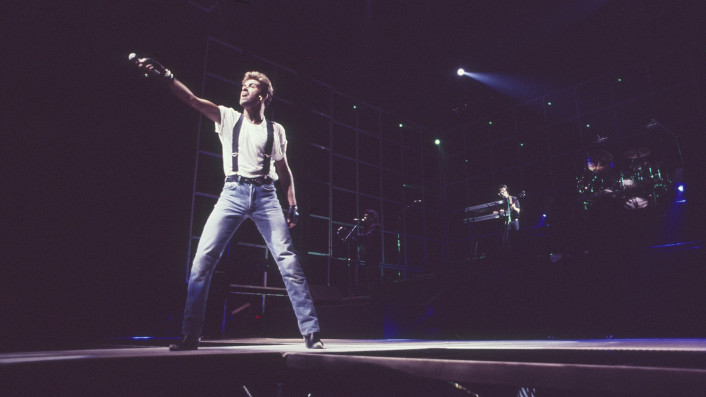
Assembled from previously unseen footage filmed over two nights at the Palais Omnisports de Paris-Bercy in 1988, the concert film captures Michael at the height of his first great solo triumph. Originally shot on 35mm film using 14 cameras, the footage has been restored and remastered for a theatrical release.
The result is good. Occasionally very good. But given the calibre of the artist and the extraordinary songs at its disposal, it never quite becomes the big-screen event it might have been.
The film opens with Finding Faith, a short documentary directed by Mary McCartney that offers some welcome context to Michael’s remarkable ascent. Featuring archival material, photographs and the singer’s own reflections, it’s a reminder of the complicated young man behind the carefully constructed superstar image.
Then we’re transported to Paris in 1988, where Michael, dressed in the leather jackets, tight jeans and trademark sunglasses of the period, sets about demonstrating why he was one of the biggest entertainers on the planet.
And, boy, does he move.
There is an extraordinary amount of running up and down ramps. Michael charges across the stage, bounds from one level to another, dances, struts and occasionally appears determined to cover every available square metre of the venue. At times, you wonder whether the stage designer was being paid by the incline.
It’s energetic, certainly, but not always particularly cinematic.
For all the effort that has gone into restoring the footage, the film frequently resembles an extended MTV concert special rather than a fully realised big-screen epic. The camera angles, editing and staging belong unmistakably to the late 1980s, when concert films often prioritised movement and spectacle over intimacy and atmosphere.
There’s nothing inherently wrong with that. Indeed, part of the film’s charm is its ability to transport us back to an era of enormous stages, elaborate choreography and pop stars who were expected to work extraordinarily hard for their money.
But the relentless movement occasionally becomes a distraction. You find yourself wishing the cameras would settle down, allow Michael to stand still and simply let him sing.
Because when he does, the results are magnificent.
The songs, of course, are peerless.
Father Figure, Faith, Everything She Wants, I’m Your Man and Monkey remind us of an artist operating at an astonishing creative level. Michael had an almost supernatural ability to combine pop immediacy with emotional sophistication, wrapping heartbreak, desire and vulnerability in melodies that sounded as though they’d always existed.
And then there’s the voice.
Even amid the choreography and constant movement, Michael sings with remarkable control, power and feeling. There’s a warmth and richness to his delivery that separates him from many of his contemporaries. He could be playful, seductive, wounded or exuberant, sometimes within the same song.
It’s also fascinating to watch him at this particular point in his career.
At just 24, Michael had already experienced extraordinary success, yet there was still so much ahead of him. The more introspective artist who would emerge with Listen Without Prejudice Vol. 1 was only a few years away. So, too, were the battles over fame, privacy and artistic independence that would come to define much of his subsequent career.
Watching him now, nearly ten years after his death, brings an unavoidable poignancy to the proceedings.
Here is a young man at the absolute summit of popular culture, seemingly invincible, commanding an adoring audience and singing songs that would outlive him by generations.
Yet we know how the story unfolds.
In that respect, The Faith Tour succeeds brilliantly as a time capsule. It preserves not only an extraordinary performer but an entire moment in pop history, when the music video was king, MTV shaped the culture and the world’s biggest stars seemed almost impossibly glamorous.
What it doesn’t always do is transcend that moment.
The greatest concert films — from Stop Making Sense to The Last Waltz — manage to become something more than documents of a performance. They use cinema to reveal something about the artists, the music and the relationship between performer and audience.
The Faith Tour doesn’t quite reach those heights.
Its visual language remains rooted in the period in which it was filmed, and while the restoration is impressive, the presentation rarely transforms the material into something truly cinematic.
Perhaps that’s an unfair expectation. After all, the footage was never originally intended to become a complete theatrical concert film. Its survival and restoration are achievements in themselves.
And for fans who never had the opportunity to see Michael perform during this extraordinary period, the film offers something genuinely precious.
Ultimately, George Michael: The Faith Tour is a welcome reminder of an artist whose talent was so considerable that even a less-than-perfect concert film remains worth watching.
The songs are timeless. The voice is magnificent. The charisma is undeniable. But the film does have enough visually ‘in’ it to make it memorable. For the most part it’s George running up and down ramps and never dropping a note.
Verdict: 3/5 stars
A fascinating and frequently exhilarating portrait of George Michael at his commercial peak. The music is magnificent, but the film itself never quite achieves the cinematic grandeur its subject deserves.