
Springsteen’s Dark Night of the Soul — and the Movie That Finds the Light Inside It
By Mitchell Peters
Autumn, 1981. Bruce Springsteen is 31, coming off The River tour like a prizefighter stepping out of the ring—victorious, exhausted, buzzing with the strange silence that follows deafening applause. Columbia wants more hits, more hooks, more E Street thunder. Bruce wants none of it. He drifts back to the Jersey Shore and into a quiet house in Colts Neck, where the nights are long and the walls start talking. The studio can wait. The noise inside him can’t.
“That’s when the quiet got a little loud,” writer–director Scott Cooper says now. If you’ve ever loved Nebraska—the hushed, haunted cassette Bruce cut in his bedroom in early ’82—you understand the frequency Cooper’s tuned to. “At its core,” he says, “this is the story of a neglected soul repairing himself through music.” It’s not the Boss in neon across an arena Jumbotron. It’s the man alone with a four-track, the hum of a lamp, a guitar that sounds like a floorboard creaking at 3 a.m., and characters clawing for a reason to believe.
The Bedroom Sessions That Became a Myth
The ingredients of Nebraska are folk horror and American prayer: Flannery O’Connor short stories, Terrence Malick’s Badlands, the Starkweather murders, the spectral pulse of Suicide’s debut, and the old ghosts from Freehold—especially the big one: his father. Springsteen records ten spare songs to stop the bleeding, not to top the charts. When the band tries to “properly” recut the material, the life drains out. The cassette remains the truth: a raw ledger of America’s lonely and Bruce’s own depression, not yet named but already narrating his dreams. Forty-plus years on, those songs are still out there at the edge of town, headlights off, idling.
From Page to Screen, Without the Halo
The road to Springsteen: Deliver Me from Nowhere begins with Warren Zanes’ acclaimed book and an obsession: producer Eric Robinson hears Zanes on WTF with Marc Maron and can’t shake the idea. He brings it to Ellen Goldsmith-Vein at Gotham, who sees a chance to rethink the rock biopic—no Wikipedia timeline, no museum glass between you and the subject. “We weren’t making a documentary,” Goldsmith-Vein says. “We wanted a narrative about a specific season of a life.”
The short list of directors turns into a short name. “We both thought: it’s Scott Cooper,” Robinson says. Crazy Heart proved he can film music as lived experience; Out of the Furnace showed he understands the weather of working-class America. Cooper doesn’t blink. “Who isn’t a Nebraska fan?” he replies to the producers’ first email. He buys Zanes’ book, dives into the deep end, and surfaces with a plan: no hagiography, no cradle-to-now coronation—an intimate, narrow frame with an epic emotional scope.
“I wanted to strip away the mythology,” Cooper says. “Before the massive stadiums. Before the synths. Before Born in the U.S.A. Just Bruce, the four-track, and the questions you ask when you’re lost.”
Winning Over the Gatekeepers
There’s a final door every Springsteen story must pass through: Bruce and Jon Landau. Zanes fires off an email. Landau answers—quickly. He’s a fan of Cooper’s work. Bruce is about to tour; brace for a wait. Then life reroutes the schedule. A peptic ulcer halts the roadshow, and suddenly there’s time for a meeting in New Jersey. Cooper and Springsteen sit down without the pageantry. They talk films, ghosts, the gravity of songs.
“I’d seen Crazy Heart, so I knew Scott knew how to handle music,” Springsteen says. “Out of the Furnace told me he could capture blue-collar life.” Most crucially, Bruce understood Cooper wasn’t chasing an impersonation or a greatest-hits montage; he was after the inner weather of 1981–82. “He felt like the right guy.”
From there the collaboration becomes unusually intimate. “Jon and Bruce were remarkably generous,” Cooper says. They weigh in on everything—production design, wardrobe, casting—always to protect authenticity. Sometimes Springsteen keeps his distance from a scene he knows will be heavy. Sometimes he’s there, not as a legend but as a partner, handing over details he’s never shared before. Landau sums it up with the gravity it deserves: “It’s the first time in 50 years that Bruce has ever handed the wheel to someone else.”
Loss, Fire, and a Guitar From a Friend
The production is bookended by personal earthquakes. Cooper’s father—the man who introduced him to Nebraska—dies the day before filming begins. Months later, while the crew captures an electrifying “Born to Run” concert sequence, wildfires rip through Los Angeles. Cooper’s home is gone. His wife and daughters are in a hotel. Springsteen doesn’t hesitate. He opens his home. He sends Cooper’s daughter a ’53 Gibson J-200, the same model Bruce used cutting Nebraska. “That’s who he is,” Cooper says. “Generous. Humble. Deeply human.” The film becomes more than a production; it’s a ledger of kindness.
Casting the Essence, Not the Echo
“They don’t teach swagger at Juilliard,” Cooper laughs. “You either have it, or you don’t.” To play Springsteen, he taps Jeremy Allen White—intense, vulnerable, watchful—the actor already carrying a little of Bruce’s working-man electricity in his shoulders. White hesitates; who wouldn’t? Then word comes back: Bruce thinks you should do it. The pressure shifts to purpose.
This won’t be a cover band. It’s about essence, not mimicry. White studies the interviews, the sidelong glances, the way Springsteen holds the room’s temperature. He woodsheds with guitar coach J.D. Simo and vocal coach Eric Vetro for five months. The production records the singing live—including a “Born in the U.S.A.” take at New York’s Power Station, where the album was cut in ’82. “Spine-tingling,” Cooper says. On set, Patti Scialfa sees White in costume and does a double take: “He looks like Bruce when I first met him.”
The first meeting between actor and icon happens, of course, on a stage—Wembley Stadium. During rehearsal, Springsteen pulls White up mid-“Born to Run,” locks eyes, and transfers the charge of a stadium’s worth of faith. Not a baptism—an invitation. Can you stand in the current and stay yourself?
“Jeremy didn’t do an impression,” Bruce says. “He inhabited my inner life. The camera catches that.”
The Look and the Listening
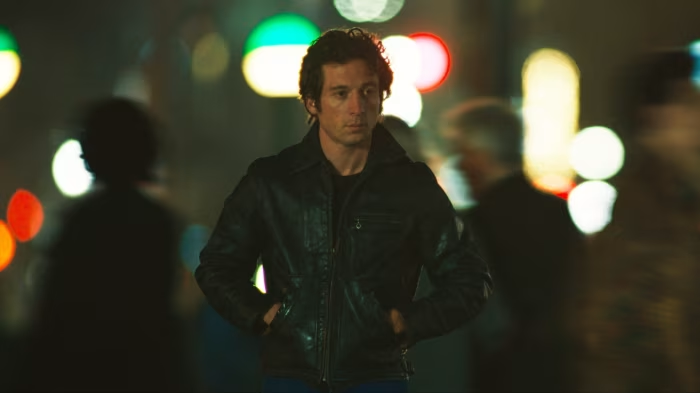
The shoot runs fall to winter—October 28, 2024, through the new year—across New Jersey (Montclair, the Shore), with stops in New York, Los Angeles, Memphis. The palette nods to ’70s cinema—grain, grit, rooms where the air looks heavy enough to touch. You can hear the lamp buzz. You can feel the cassette wheel turning. Cooper keeps the frame tight when it matters: a man at a kitchen table, words coming down like weather; a bedroom performance where a chorus becomes a confession; a band trying to improve the songs and accidentally stripping their spirit.
For as much as the film is about the making of Nebraska, it refuses to get lost in gear worship. The real instrument is solitude. Still, the fetish objects land with meaning: the battered four-track, the road-scarred acoustic, the Power Station room tone that swallows and sanctifies.
Why This Story Now
On paper, a lo-fi acoustic album from 1982 shouldn’t be the spine of a big-studio movie in 2025. On screen, it makes sense immediately. Nebraska is a field recording of the American psyche—its drifters and dreamers, its darkness and grit. It’s also a survival manual, written by a son working out how to live with the father in his head and the nation at his back. In an age that loves the spectacle of triumph, the film spotlights the craft of endurance: how you keep showing up when the crowd goes home and the mirror isn’t kind.
Cooper’s take is reverent without being soft. He honors the bedroom record without embalming it, and he has the sense to leave some questions unanswered. The movie lands in the space Springsteen wrote from—where the stories are small, the stakes are mortal, and mercy is a near-myth you can still sing toward.
The Last Word
“Bruce is called The Boss for a reason,” Cooper says, smiling, “but when it mattered most, he was just a friend.” That generosity bleeds through the frame. You can feel it in the way the film refuses to canonize and instead humanizes—the way it credits the silence as co-writer.
In the end, Springsteen: Deliver Me from Nowhere isn’t about a masterpiece so much as the making of a man in the cold hours before dawn. It’s the sound of somebody turning the volume down on everything he’s supposed to be, to hear the part of himself that still wants saving. A cassette. A kitchen table. A handful of characters staring out at an American winter. And a songwriter finding—barely, bravely—enough faith to press record.